- calendar_today August 17, 2025
A Theme Park Ride in Disguise: Fantastic Four’s Polished Soft Reboot
Marvel’s new Fantastic Four origin story, The Fantastic Four: First Steps, is pretty to look at. It’s a straightforward, stylish throwback to the earliest days of the publisher’s earliest heroes. With good, sometimes great performances across the board—particularly from Pedro Pascal and Ebon Moss-Bachrach—and a design sensibility rooted firmly in the 1960s, the movie is a slick blast of vintage Marvel superheroics. Yet for all of its eye candy and cutesy callbacks, it never really ratchets up the suspense or stakes to land with much punch.
“This is a no-homework-required movie,” Marvel producer Kevin Feige said, and he was right. Marvel movies now routinely demand a basic understanding of parallel universes and secret history and a working knowledge of every superhero cameo and spin-off in recent memory. First Steps is, happily, not one of those films. You do not need to know anything about previous Fantastic Four adaptations to follow along here. The central four characters—Reed Richards, Sue Storm, Johnny Storm, and Ben Grimm—have all been reintroduced without burdening the audience with too much of the franchise’s messy continuity history.
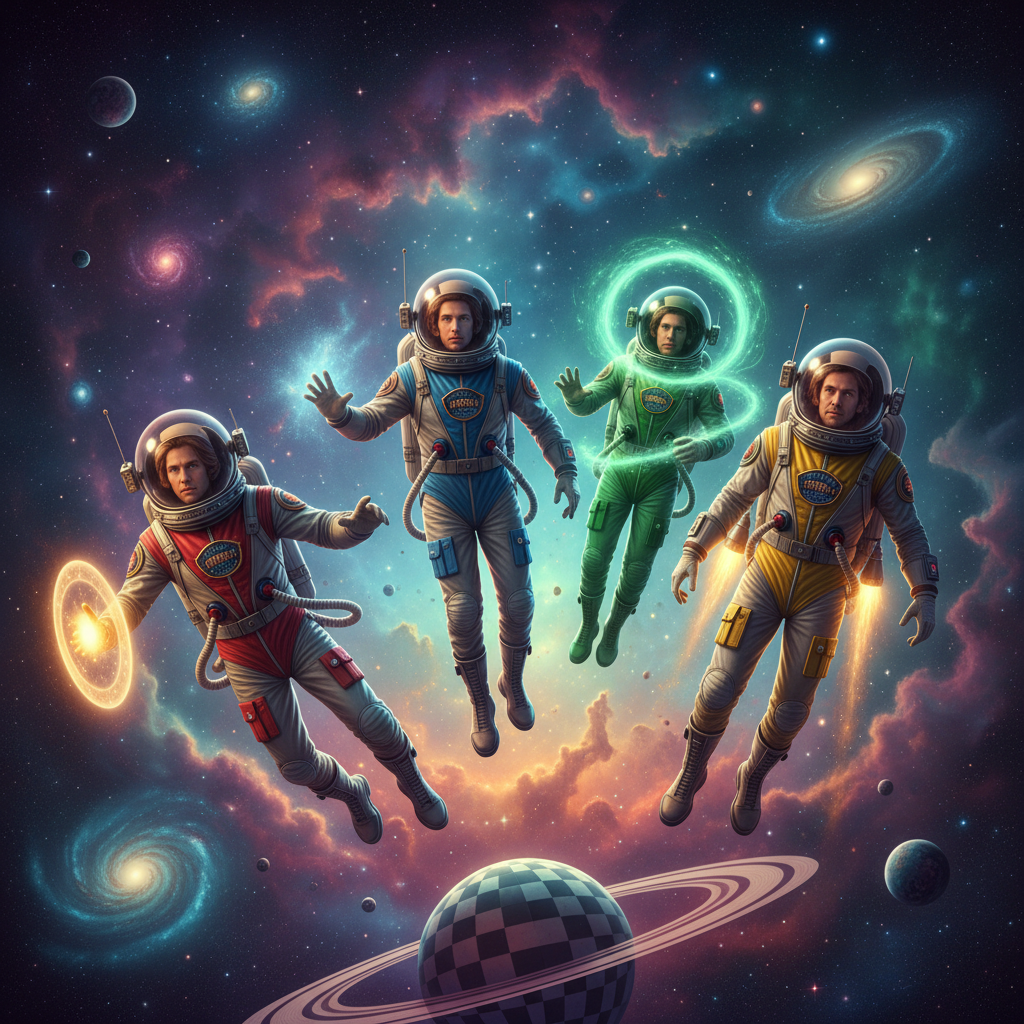
The film is also admirably content to be simple, and in many ways, too simple. (More on that later.) It begins with an easy-does-it recap in the form of a talk show hosted by Mark Gatiss, who charmingly summarizes how the Fantastic Four became the Fantastic Four. Four years before the start of the film, Reed (Pedro Pascal), Sue (Vanessa Kirby), Johnny (Joseph Quinn), and Ben (Ebon Moss-Bachrach) were space travelers who got caught in a cosmic radiation storm that mutated their DNA. Reed can stretch his body like elastic; Sue can turn invisible and project force fields; Johnny can light himself on fire and fly; and Ben Grimm is a permanently transmogrified rock monster also known as The Thing.
But the family fun will have to wait. In a rush of conveniently yellow smoke, we learn that the planet is in peril from an ageless cosmic giant in a metal exoskeleton with glowing red eyes named Galactus (John Krasinski). He’s on his way to Earth with designs on eating it and will arrive shortly, we are told, so he dispatches a silvery alien herald (motion-captured by Julia Garner) in a special winged vehicle (the Silver Surfer) to let us know. The Silver Surfer arrives with intimidating grace, though Johnny is smitten enough with her that his research into her people soon starts to take the form of a private punfest (“Surfers always wet the…wait, is she wet?”). The trouble is, it’s all still not particularly threatening, action-wise. Galactus himself is unseen for much of the running time, the battles are fought in space, and as the heroes chase him through the stars and get hit by projectiles from the Surfer, the explosions and special effects are all in keeping with the era’s aesthetics: pulses of glowing light, wisps of flame and fire-trails, sleekly geometric silver-and-blue explosions.
Sue goes into labor as they’re orbiting the planet in one of the movie’s most bizarre scenes, a burst of implausible exuberance that is less high stakes than full-on hallucinogenic. You might imagine some combination of childbirth and the end of the Earth to be fraught, but Sue’s contractions here have the manic earnestness of a Saturday-morning cartoon or a Brach’s candy advertisement. Perhaps it’s part of the film’s studied balance of silliness and sincerity, but its palette and general sweetness have an oddly deflating effect on the movie’s thrills.
Taken in its terms, the movie is like a candy shell with a soft center. It has some moments that genuinely mean what they say, but they’re often flattened out by the film’s general pastel palette. The stakes are never, ever high. Reed and the gang need to find the Surfer, but that quest is more an excuse for cosmic adventure than a matter of life and death. The building trouble with the baby and the pregnant Sue is pretty mild. Galactus comes for the planet, and it’s clearly over for everybody, but by the time he shows up, the tension is off. The resulting mix is a long way from high drama and more like a children’s adventure.
First Steps has the pedigree and the passion to be better than it is, to have more of a bite than a yawn. First of all, it’s fun to see Pascal and Moss-Bachrach together again after their recent series The Last of Us (plus it’s nice to see Moss-Bachrach outside of The Last of Us universe, too). First Steps also has strong performers in a breezy, accessible film with a blast-from-the-past retro-futuristic look. It’s genuinely a “no homework” experience, and not in the dismissive way Marvel chief Feige meant it. For fans of the previous MCU efforts (especially this year’s The Marvels), or anyone looking for a slightly silly but heart-on-sleeve superhero movie without the usual high stakes or cosmic crisis, The Fantastic Four: First Steps could be the ticket. For a much higher energy take on Marvel’s most misbegotten cinematic property, you might be better off waiting for the inevitable sequel.