- calendar_today August 14, 2025
.
After over a year of consistent month-over-month growth, US electric vehicle sales are in contraction for the first time. Consumer rejection is already happening at individual brands, including Genesis and Volvo, both of which are paring back electric vehicle lineups in response to consumer demand.
Uncertainty from the US federal government has only compounded the issue. The Biden administration has cut EV subsidies, rescinded vehicle pollution rules, and generally offered fewer buyer incentives at the federal level. However, says market research analysts, the real impediment to EV adoption may be right in your garage.
Why Charging Accessibility Matters
Consumer surveys have consistently placed charging as one of the biggest pain points for would-be EV buyers. A new report from Telemetry Vice President Sam Abuelsamid takes a closer look at how availability of charging at home can boost or hold back adoption.
Attention in the EV charging world has long focused on fast-charging stations on the national grid. However, home charging is still by far the most common. AC-powered chargers account for roughly 80 percent of all charging, the vast majority of which is performed at single-family residences (SFR).
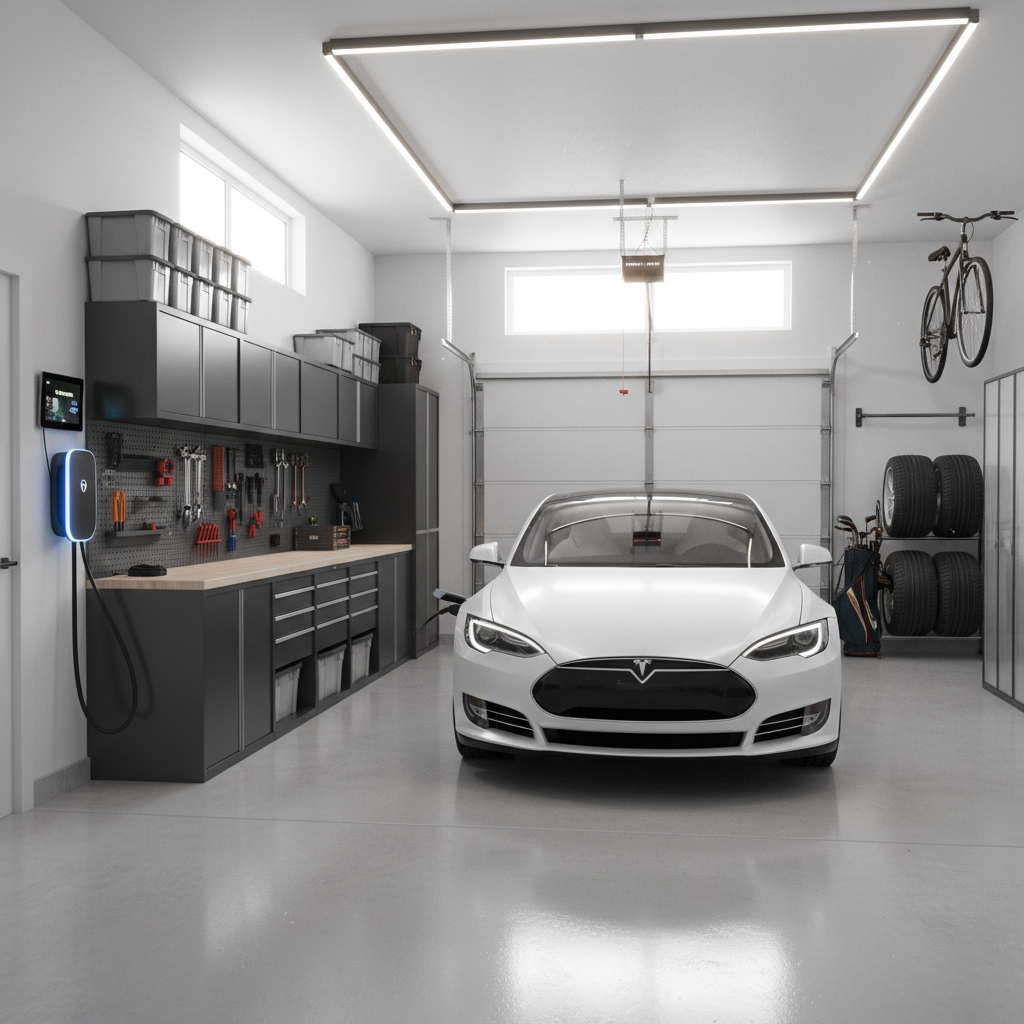
A study by the National Renewable Energy Laboratory (NREL) found that 42 percent of SFRs are already equipped with a 240-volt outlet (level 2) within reach of a parking spot. That figure could nearly double to 68 percent if homeowners made space in their garage and parked their car there instead of using it as storage.
The vast majority of homes have room to make this happen, notes Abuelsamid. “90 percent of all houses can add a 240 V outlet near where cars could be parked,” he says. “Parking behavior, namely whether homeowners use a private garage for parking or storage, will likely become a key factor in EV adoption.”
The number of homes where EV charging is possible under current conditions would climb from 31 million to over 50 million if more garages were opened to parking rather than storage. If new wiring is taken into account, that figure could rise to more than 72 million. That’s already more than Telemetry’s EV market penetration estimates for 2035, ranging as they do from 33 million to 57 million vehicles.
Papers, Please: Home Charging Limitations
Availability in theory, of course, doesn’t mean readiness in the real world. A significant barrier is the availability of electrical capacity in the home. The NREL study found nearly 34 million would need to upgrade their electrical system to support a level 2 charger. Charging a typical EV often requires at least 30 amps of dedicated power, meaning a significant number of new or replacement wires are needed.
In some cases, electrical panels will need to be replaced or upgraded. The cost to homeowners can run into the thousands of dollars.
It’s a sobering thought given one of the chief selling points of EVs: long-term cost savings. All too often, adds Abuelsamid, “costs to install or upgrade charging equipment that could be shared with multiple cars, along with the potential need to upgrade electrical service, can quickly erase these cost advantages, and in some cases, make EVs more expensive than gasoline vehicles.”
Parking in an Apartment Lot
Things are even more difficult for the 23 percent of Americans who live in multifamily homes like condos, apartments, and townhomes. Individual electric vehicle owners almost never have the autonomy to add a charging station in such dwellings. They are at the mercy of landlords, property managers, co-op boards, or other forms of management when it comes to permission and approval. Unfortunately, getting that approval is by no means a guarantee.
Cost is another challenge. The same NREL study used a co-op board’s decision to install a pair of shared level 2 chargers as a case study. The first item on the docket? Upgrade the entire electrical panel. A task with price tags in the millions. Running wire to remote parking spots adds to the cost, and unlike SFRs, dwellers in these buildings are typically excluded from most municipal or utility funding to cover costs.
Today, about one million EV owners in the US live in multifamily buildings, and only 11 percent of them are parked in a spot near a charging outlet. While some states have or are planning requirements for 20–25 percent of parking spaces in new developments to be charging-capable, Telemetry estimates even in 2035 there will only be 6.7 million to 11.4 million spaces equipped with chargers in these buildings.
After factoring in projected EV adoption in all housing types, Telemetry analysts still estimate a demand shortfall of some 6.6 million to 13.6 million chargers in these buildings alone.
Public Charging Infrastructure Must Scale
The obvious solution to limited home charging is public infrastructure. According to Telemetry’s forecast, between 11.7 million and 14.3 million EV owners who will live in single-family houses will also be using public charging by 2035. Another 7.8 million to 8.1 million owners living in multifamily dwellings will also have to count on public stations. This is even if charging is accessible at home.
Meeting that demand will take 523,000 to 586,000 DC fast chargers, plus another 1.5 million to 1.6 million level 2 chargers across the US. The question, then, becomes how to fund, approve, and roll out such a large number of sites. Electric companies are already feeling the strain as they grapple with AI data center expansion. Neither mayors nor ratepayers are exactly thrilled to see power generation and distribution capacity siphoned off for charging.
Bottom Line: Charging Limits EV Adoption
EVs continue to be one of the more promising environmental stories in the US. However, this lack of accessible charging is going to hinder the rapid adoption that many in the industry have become accustomed to. Home garages may have the space for charging, but clutter can get in the way. The electrical capacity to upgrade may exist, but the cost of doing so can be a hard pill for homeowners to swallow. Multifamily housing is an entirely different challenge.
On the public side, there is an argument to be made that capacity will expand with demand. The infrastructure investments are too large and too attractive not to. The question is whether that growth will be able to keep pace with the potential that EVs have to reduce carbon emissions.