- calendar_today August 16, 2025
Growing energy requirements for artificial intelligence systems drive worldwide efforts to discover more sustainable and efficient computing technologies. Although ongoing optimization of existing hardware and software systems is important, quantum computing represents a groundbreaking development by introducing a fundamental departure from traditional computational methods.
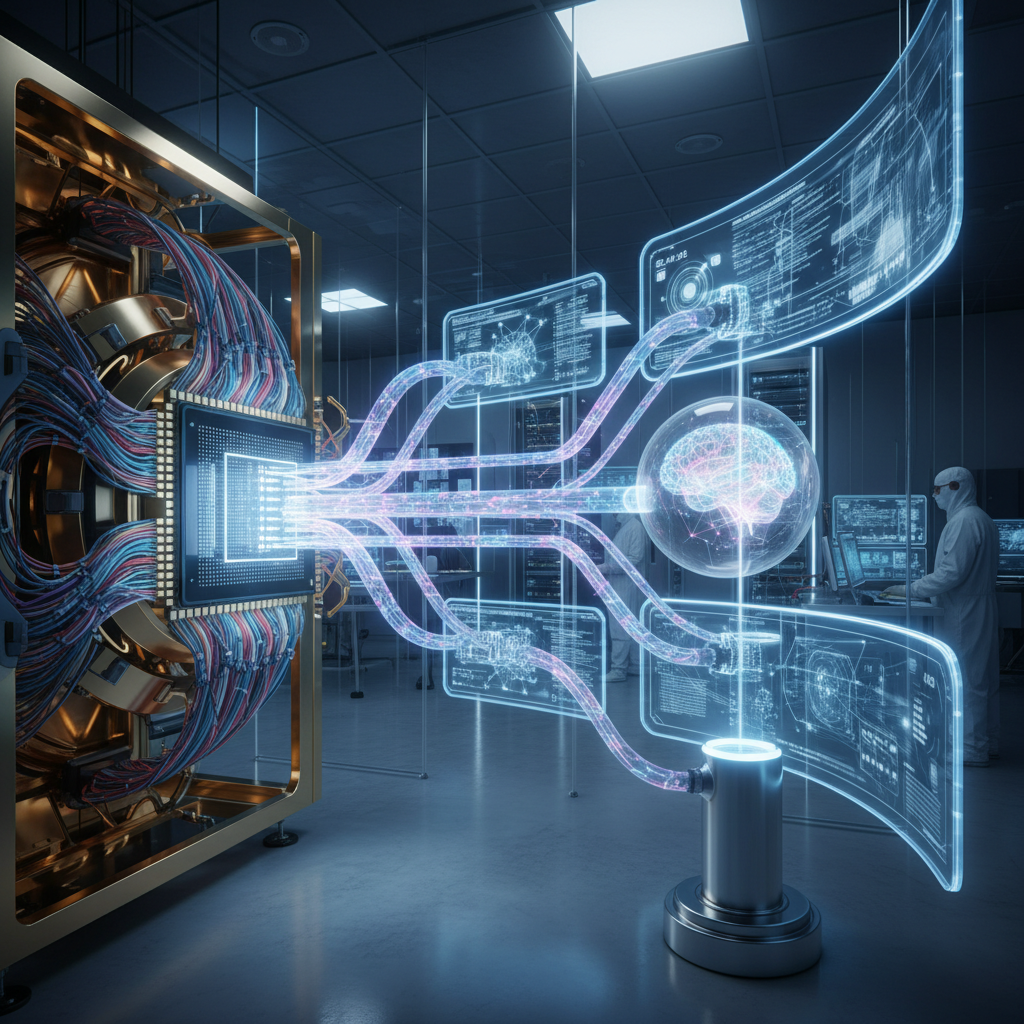
Quantum computers utilize principles from quantum mechanics like superposition and entanglement to potentially deliver exceptional processing power for AI tasks and address energy consumption issues in complex AI models.
The current AI revolution stands on classical computers, which process information through bits that function as binary 0 and 1 values. In contrast, quantum computers utilize qubits. Qubits maintain the ability to be in multiple states at once so they can simultaneously represent binary values of 0 and 1.
Quantum computers achieve high computational efficiency for certain calculations because qubits exist in superpositions and become entangled to create interconnected state correlations. This capability holds transformative potential for artificial intelligence applications. The complex mathematical procedures involved in machine learning algorithms that establish modern AI foundations require extensive computational resources for matrix multiplications and optimizations on traditional systems.
The theoretical capabilities of quantum computers to explore numerous possibilities at once make them ideally suited for AI operations, which could result in substantial speed enhancements for training and inference tasks.
Quantum computing technology remains at an early developmental stage. Quantum processors today have limited qubit numbers and substantial error rates that make them incapable of executing complex AI models. Researchers dedicate their ongoing studies to overcoming these technical obstacles.
The implementation of error correction plays a vital role in attaining reliable results from quantum computations. The powerful benefits quantum computing offers to AI research drive researchers and industry leaders to fund its development despite existing challenges. The ultimate goal involves developing quantum computers that can handle numerous qubits without errors, which will enable researchers to solve highly complex AI problems that today’s supercomputers cannot manage.
Breakthroughs in drug discovery, materials science, and financial modeling appear possible through these advancements, which will be strengthened by future developments in AI technology.
A major development in proving quantum computing’s capabilities for AI has been achieved through research dedicated to image classification tasks. The study team successfully moved image data from classical systems to quantum processors and completed a basic classification task. This draft paper demonstrates the advancements in making connections between classical data origin points and their processing within the quantum realm.
The study demonstrates that quantum computers exist beyond theoretical speculation because they can run AI algorithms on real hardware systems. The researchers investigated techniques to transform classical image data, where pixels represent quantum states that quantum computers can interpret and process. Researchers used quantum circuits consisting of quantum operations to execute the classification process.
Potential Impact of Quantum AI
The implications of this research are far-reaching. The rising complexity and data demands of AI models have escalated energy consumption during their training and operation into a major issue. Quantum computing enables more efficient computation, which holds the potential to create sustainable AI systems.
Envision a scenario where we train large language models much faster and with reduced energy consumption beyond what today’s classical systems allow. Reducing AI’s environmental impact through quantum computing can democratize access to AI development for researchers and developers who lack substantial resources.
Quantum computing for artificial intelligence has not yet reached widespread adoption, but recent advancements in image classification demonstrate its future transformative capabilities. Research and development work continues to expand potential limitations that enable quantum computers to become a foundational element for future AI systems.
The advancement of quantum hardware through higher qubit counts and reduced error rates will enable practical quantum AI applications to develop and tackle many of the planet’s critical challenges while promoting innovation. Quantum computing combined with artificial intelligence creates a fundamental change that will transform computational futures while directing scientific research and technological progress in new directions.
Quantum Computing and AI Synergy
Quantum computing combined with artificial intelligence provides significant opportunities for advancements through collaborative growth. Artificial intelligence assists quantum hardware and software development through quantum circuit design optimization, along with error correction improvement and automatic discovery of new quantum algorithms.
Quantum computing delivers the computational power required to address sophisticated AI challenges which resulting in the development of more effective AI models. The mutual enhancements between these two domains will speed up advancements for both technologies and create breakthrough innovations that neither could achieve independently.
Challenges and Future Directions
While quantum computing shows great potential for enhancing AI capabilities substantial difficulties persist before its full benefits can be achieved. Developing fault-tolerant quantum computers on a scalable basis constitutes a major engineering obstacle. The resolution of problems related to qubit decoherence, gate errors, and scalability stands as a critical requirement.
Research continues to focus on creating quantum algorithms that harness quantum hardware capabilities for targeted AI applications. Quantum programming languages and software tools development play an essential role in extending quantum computing accessibility to various researchers and developers.
Quantum Computing Fundamentals
Today’s AI revolution relies on classical computers, which use bits that represent information in binary form through either 0 or 1. Quantum computers, however, utilize qubits. Qubits possess the unique ability to be in multiple states at once, which allows them to embody both 0 and 1 simultaneously.
Quantum computers achieve superior performance on specific computations because of qubit entanglement, which creates interconnected states alongside quantum superposition. The potential to revolutionize AI exists because quantum computers excel in handling the complex mathematical operations required by many machine learning algorithms.