- calendar_today August 8, 2025
.
The president is trying to take credit for brokering peace in various hot spots around the world. He boasted that he had ended six wars, during a press conference at the White House on Monday with the president of Ukraine Volodymyr Zelensky and other world leaders, as a way to make the case that he has the credentials to bring about a Ukrainian breakthrough.
“Let me just tell you about the wars we have — and in many cases I’m not even going to call them wars, because they’re right in the middle of getting stopped and you’re going to have to do it as a country, you know that,” Trump said during the meeting. “I’ve done six wars. I’ve ended six wars. Look, India-Pakistan, we’re talking about big places. You just take a look at some of these wars. You go to Africa and take a look at them.”
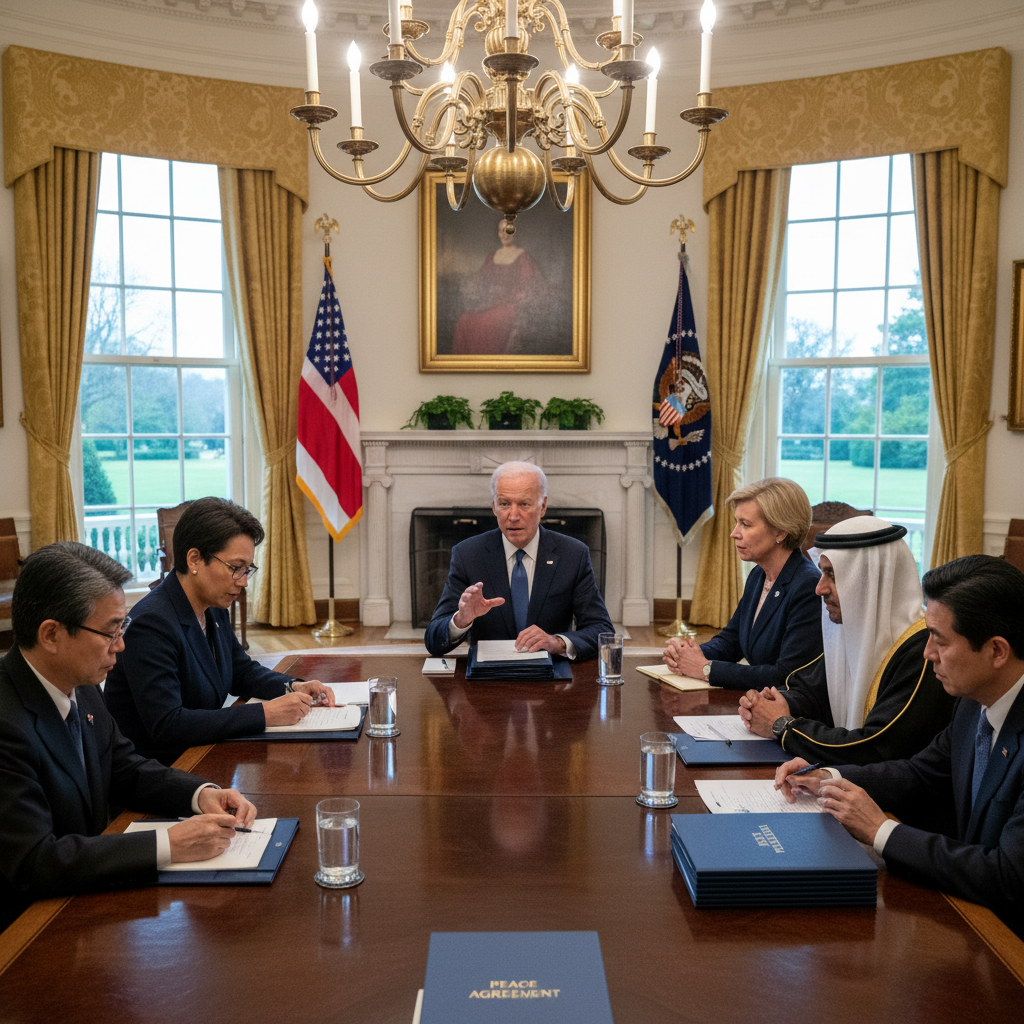
The president took to Twitter to post photos of his meeting with leaders, and returned to the theme of his ability to end wars.
“President @realDonaldTrump says it has been an honor hosting the leaders of Ukraine, Israel, Germany, France, Italy, and Romania at the White House this week to discuss many pressing issues, including ending longstanding wars,” a tweet from the White House read. “In particular, the president is focused on how to end the war between Ukraine and Russia.”
‘President of Peace’
The White House had put out a statement at the end of last month, billing Trump as the “President of Peace,” while listing an array of agreements or diplomatic initiatives across different regions.
The administration has pointed to breakthroughs between Armenia and Azerbaijan, Cambodia and Thailand, Israel and Iran, Rwanda and the Democratic Republic of the Congo, Egypt and Ethiopia, and Serbia and Kosovo, as examples of progress toward peace, while Trump’s team has signaled his potential candidacy for a Nobel Peace Prize.
Critics say that the president’s record is inflated, while some of the “peace” agreements are little more than temporary ceasefires.
Prominent ceasefires include agreements between Armenia and Azerbaijan, and more recently Israel and Iran. The White House boasted of a truce following a 12-day conflict, though years of hostility remain between the two countries, and the U.S. has played an active role in carrying out strikes on Iran’s nuclear facilities over the years.
U.S. Offers Energy Hub to Armenia and Azerbaijan
In the most recent case, Trump intervened to broker peace between Armenia and Azerbaijan following a border flare-up that erupted into intense fighting in September, with at least 38 dead. He pushed both sides to reach a cease-fire agreement at the White House, backed by carrots like U.S. investment in an energy hub to help bring stability to the region.
The pact also created a U.S.-controlled transportation corridor, called the “Trump Route for Peace and Prosperity.” After meeting with Trump, the president of Azerbaijan, Ilham Aliyev, gushed, “In six months, President Trump has done a miracle.” Aliyev’s office also offered to nominate Trump for a Nobel Peace Prize, an honor that went to President Barack Obama during his first year in office.
But analysts warn that difficult territorial disputes will remain an issue. Under the Trump administration, Armenia and Azerbaijan normalized some ties, but Trump stopped short of offering a permanent resolution to their competing claims over Nagorno-Karabakh and other regions.
Pressure on Asia
Trump has used a different type of leverage in Southeast Asia, threatening to suspend trade deals to halt a border conflict between Cambodia and Thailand that broke out in June, after a year of rising tensions over territory along their shared border. The conflict killed at least 38 people and displaced tens of thousands of Cambodians before a cease-fire took hold. Trump’s approach, which rattled both countries, may have helped bring the fighting to a halt. The Association of Southeast Asian Nations — a bloc representing 10 countries in the region — eventually supported the cease-fire agreement.
The president has also nominated himself for a Nobel Peace Prize after using his leverage as a top trading partner to pressure Cambodia to stop the fighting. Cambodia’s Prime Minister Hun Manet said his country’s agreement to cease hostilities came “after extraordinary statesmanship from President Trump.”
Trump Lashes Out at Allies During Call with Korean Leader
In the same month, the president also waded into a border flare-up between India and Pakistan. While Pakistan praised Washington’s role in playing a back-channel role, India rebuffed the notion of U.S. mediation. Trump also drew attention in the region through his efforts to broker peace with North Korea during high-profile summits with the country’s leader, Kim Jong Un. Despite that high-level attention, the North Korean regime has continued to develop its nuclear program and will be one of the thorniest issues on Trump’s legacy.
Rwanda and the D.R. of the Congo
Trump has also pointed to a deal between Rwanda and the D.R. of the Congo that saw both sides make commitments to recognize each other’s borders and renounce the use of militias and war. But the M23 rebel movement rejected the agreement in a statement, raising questions about the deal’s impact. Some analysts believe the deal is linked to U.S. competition with China for African mineral resources.
The president has also made reference to Egypt and Ethiopia, which have been in a dispute over an enormous dam project being built by Ethiopia on the Nile. Trump weighed in last month, saying both sides should compromise. No binding agreement has been announced since.
Serbia and Kosovo
The administration has also pointed to economic normalization measures agreed to between Serbia and Kosovo, although that work began during Trump’s first term in the White House. The two countries remain without full diplomatic relations, and European Union mediation has featured most of the negotiations in recent years.
Peace Deals Critics
Trump’s style of peacemaking has drawn praise and criticism. Some analysts say his efforts to make big, public deals undercut the painstaking and often anonymous diplomacy that can be required for real results. His efforts to slash funding to the U.S. Agency for International Development and the hollowing out of State Department staffing under his watch, many experts say, means Washington has fewer tools to solidify agreements.
But some in Washington see effective diplomacy under Trump, including with India and Pakistan last month. “The ones that were helpful in these particular crises, they were conducted in a professional way, quietly, diplomatically … finding common ground between the parties,” said Celeste Wallander, a former assistant secretary of defense who now works at the Center for a New American Security. “That’s how they made a difference.”